Toon Tone vs Dialed GG: Which Color Memory Game Is Harder?
Toon Tone and Dialed GG look similar at first: both ask you to recreate colors from memory with slider controls. But the two games are hard in different ways.
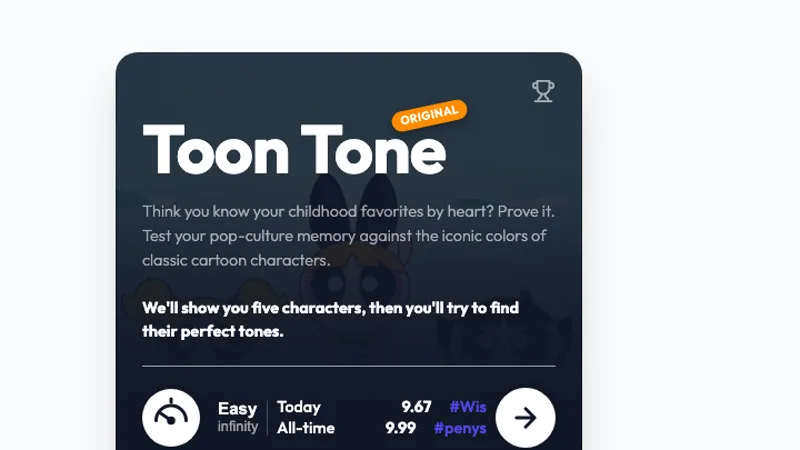
Toon Tone gives the color a cartoon context. Dialed GG removes context and turns color recall into a raw memory test. If you want to improve faster, it helps to understand what each one is actually training.
The Short Version
Play Toon Tone if you want a color game with recognizable prompts, cartoon memory, and quick rounds that feel like a visual quiz.
Play Dialed GG if you want a stricter memory drill where you study colors, lose the reference, and rebuild them as accurately as possible.
Both are useful. Toon Tone is easier to start. Dialed GG is usually harder to master.
Looking for "Dialed GG Cartoon" or "Dialed with Characters"?
If you remember a question about the color of a named cartoon character's body, clothing, or accessory, start with Toon Tone. The original Toon Tone game uses character prompts, while Dialed's color game describes a challenge built around remembering five colors.
The controls can make the games look familiar, but the prompt tells you which format you saw. A named character part points to Toon Tone; a plain color to memorize points to Dialed's color game. This comparison concerns those two formats and does not claim that every similarly named game uses the same rules.
For concrete examples, see our Toon Tone characters and target parts. If you want the swatch-based challenge, play Dialed GG.
How Toon Tone Tests You
Toon Tone's difficulty comes from familiar colors that are less precise in memory than they feel. You may know the character instantly, but that does not mean you know the exact shade.
The cartoon prompt gives you a starting point. That helps beginners because the round has meaning: body color, outfit color, hair color, accessory color. But it can also trick you. Your brain may remember the category instead of the actual tone.
That makes Toon Tone a good test of:
- Character color memory.
- HSB slider control.
- Recognition versus exact recall.
- Small differences in saturation and brightness.
If you miss often by making colors too bright or too saturated, read the Toon Tone strategy guide, then play another round of Toon Tone.
How Dialed GG Tests You
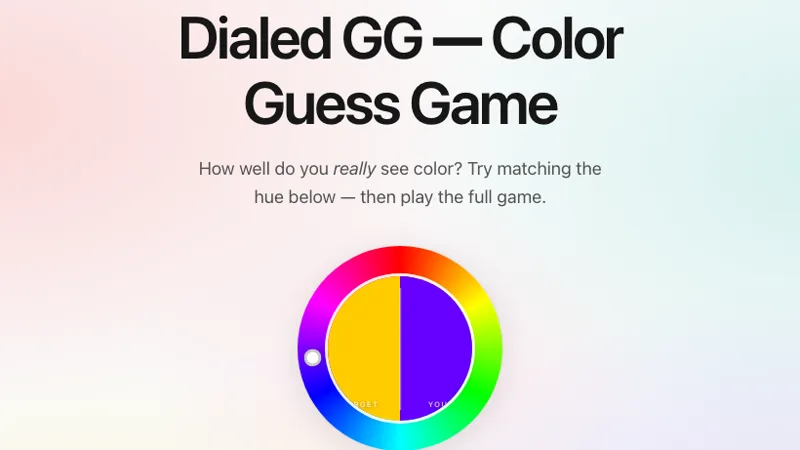
Dialed GG is more direct. It shows colors, removes them, and asks you to recreate them from memory. There is no character clue to lean on.
That makes the game feel cleaner and more punishing. You are not asking, "What color was that character?" You are asking, "Can I hold this exact visual sensation in my head long enough to rebuild it?"
Dialed GG is strong for:
- Pure color recall.
- Fast visual working memory.
- Comparing multiple colors in one session.
- Learning how quickly a remembered color drifts.
The official Dialed game also emphasizes perceptual color distance, which means the score is designed around how humans see color differences rather than simple numeric slider distance.
Which One Is Better For Beginners?
Start with Toon Tone. The prompts are more approachable, and the cartoon hook makes the first few rounds easier to understand.
Once you know how hue, saturation, and brightness interact, add Dialed GG. It will expose weaknesses Toon Tone can hide. If your Toon Tone guesses are helped by character familiarity, Dialed GG removes that help.
The best order is:
- Toon Tone for context-based color memory.
- Hued for daily feedback and precision.
- Dialed GG for raw recall.
- Hexcodle if you want to connect visual color with hex values.
Which One Is Harder?
Dialed GG is usually harder as a memory test because it gives you less context. You either remember the color or you do not.
Toon Tone can be harder in a different way: it fights your assumptions. Familiar cartoon colors feel obvious until you try to rebuild them. The gap between "I know that character" and "I know that exact shade" is where the game gets interesting.
So the answer depends on the skill:
- Harder for pure memory: Dialed GG.
- Harder for cartoon color assumptions: Toon Tone.
- Better daily warm-up: Hued.
- Better numeric color training: Hexcodle.
The Best Practice Combo
Use the two games together. Play one Toon Tone run first, then one Dialed GG run. If your Dialed score drops sharply, your color memory depends heavily on context. If both scores are close, your raw recall is probably improving.
That is the real value of comparing them. You are not just choosing a favorite game. You are learning what kind of color memory you actually have.
Further Reading
- Play Toon Tone
- Play Dialed GG
- Play Hued
- What Is Toon Tone? A Beginner's Guide
- Train Your Color Eye in 5 Minutes a Day
Looking for sound or note matching? Our Dialed GG guide covers Dialed Sound, scoring, and mobile audio.