Toon Tone Strategy Guide: How to Guess HSB Colors More Accurately
The fastest way to get better at Toon Tone is to stop thinking in color names.
"Yellow" is not enough. Neither is "blue" or "red." Toon Tone scores the exact shade you build, so a good guess needs three decisions: hue, saturation, and brightness. If you make those decisions in a consistent order, your scores become easier to improve.
1. Set Hue Before Anything Else
Hue is the color family. It answers the first question: where is the shade on the color wheel?
In Toon Tone, start every round by finding the closest hue before touching saturation or brightness. If the character color feels orange-yellow, do not settle for plain yellow. If a blue leans cyan, move it toward cyan before judging anything else.
This prevents the most common mistake: using brightness to compensate for a wrong hue. A dark wrong blue is still the wrong blue.
For extra hue practice, play Hued. Its daily format trains the same first step, but with feedback after each guess.
2. Judge Saturation By Cartoon Style
Saturation is how strong the color feels. Cartoon colors often look more saturated than real-world objects because animation needs readable shapes and fast recognition.
A useful Toon Tone habit:
- If the color feels iconic or mascot-like, start with higher saturation.
- If it feels like clothing, fur, hair, or shadow, pull saturation down.
- If the color looks almost gray, fix saturation before changing hue.
Many close guesses fail because the hue is right but the color is too clean. A slightly muted red and a pure red can feel like different characters.
3. Treat Brightness As The Final Polish
Brightness is the last slider to adjust because it changes your perception of the other two. A very bright color can look less saturated than it is. A dark color can make the hue feel cooler or warmer.
Once hue and saturation are roughly right, ask a simpler question: should the color read as light, mid, or dark?
Do not overcorrect. Small brightness moves often matter more than they look, especially on cartoon yellows, skin tones, and blue outfits.
4. Compare Your Mistakes After Every Round
The score is less useful than the direction of the miss. After you reveal the result, look for one pattern:
- You were too warm or too cool.
- You were too vivid or too muted.
- You were too light or too dark.
Write the pattern mentally, then apply it on the next round. This turns Toon Tone from a one-off guessing game into a quick color training loop.
5. Use Other Color Games For Specific Weak Spots
Different color games train different parts of the same skill.
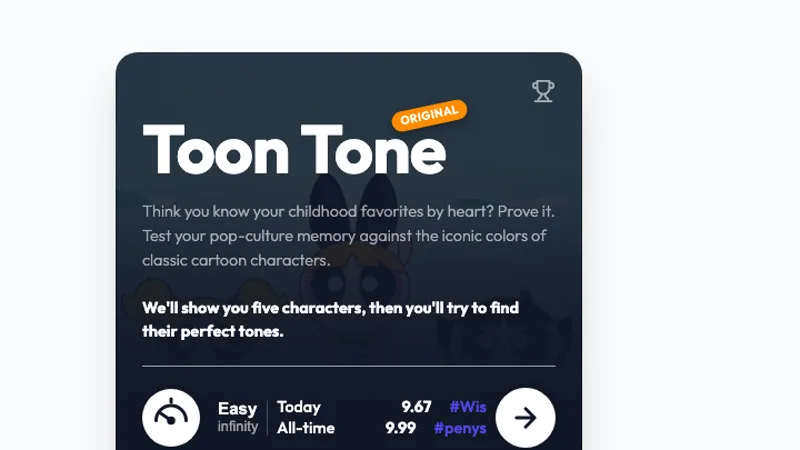
- Toon Tone trains character-based color recall.
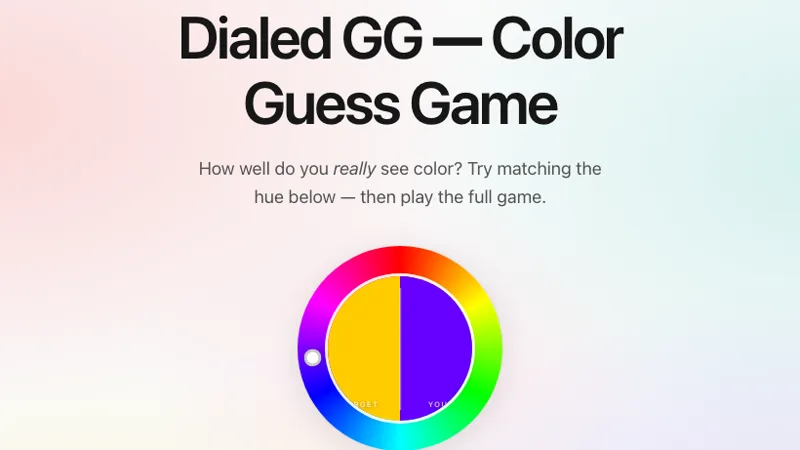
- Dialed GG trains raw visual memory across five colors.
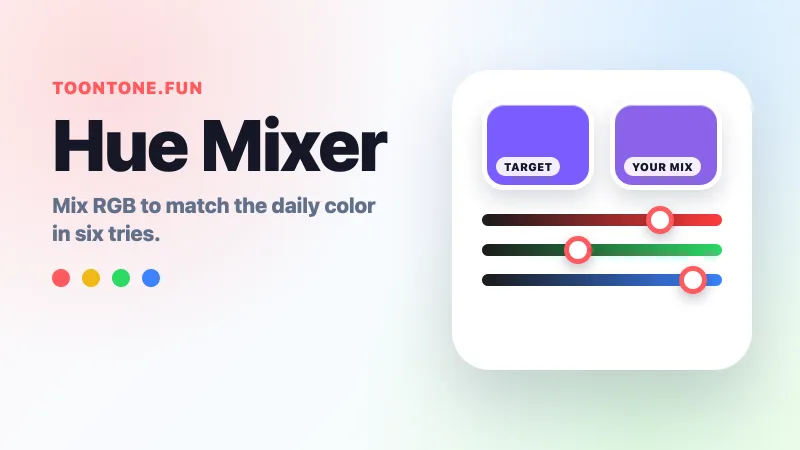
- Hexcodle trains RGB and hex intuition.
- Hue Sort trains ordering and relative hue judgment.
- Color Guessr trains broad color estimation.
If your Toon Tone misses are mostly hue errors, play Hued or Hue Sort. If your misses happen after the color disappears, play Dialed GG. If you understand colors visually but not numerically, add Hexcodle.
6. Build A Five-Minute Routine
Here is a simple daily loop:
- Play one Toon Tone run.
- Note your biggest miss type.
- Play one supporting game: Hued, Dialed GG, or Hexcodle.
- Return to Toon Tone for one final run.
That is enough. The goal is not to grind for an hour. The goal is to make your eye notice one more distinction each day.