
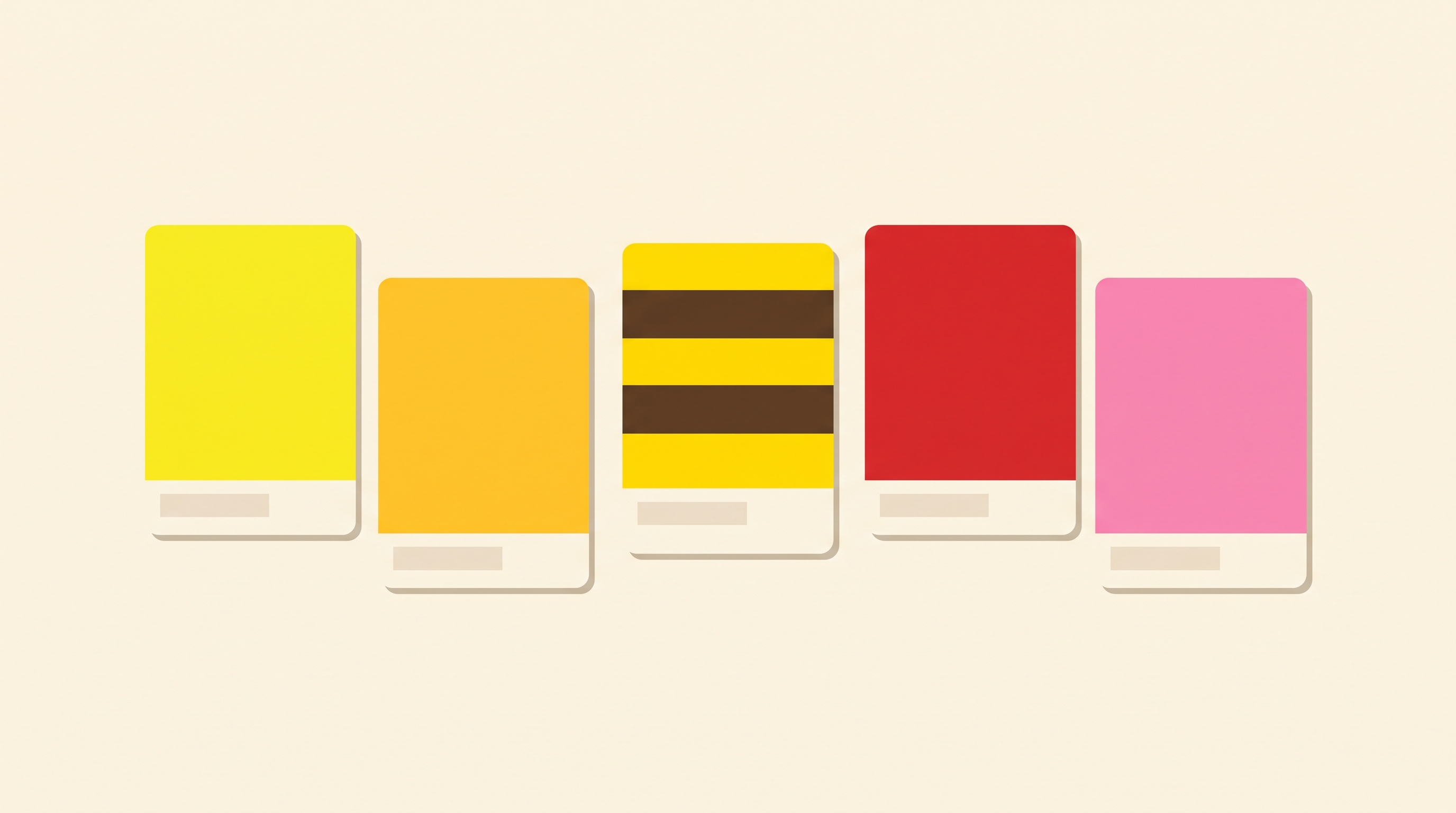
The Iconic Cartoon Colors You Probably Misremember
Ask ten people what color SpongeBob is. They'll all say yellow. Ask them to pick that yellow from a color wheel and you'll get ten very different swatches. This is the gap Toon Tone lives in — the space between "I know this character's color" and actually being able to reproduce it.
Here are five characters whose colors are more specific (and weirder) than you remember.
SpongeBob Yellow Is an Official Pantone Color
In 2019, for SpongeBob's 20th anniversary, Pantone and Nickelodeon released two official shades: SpongeBob Yellow and Patrick Star Pink. Most fan-built palettes settled on hex codes like #FFF56C (close to Pantone 100 C) for SpongeBob's body, though brand references vary between a brighter #F7E948 and a slightly more muted variant.
The interesting part: most people, asked to mix SpongeBob yellow from memory, land on a saturated school-bus yellow. The real thing is paler, softer, and warmer. There's an actual sponge under all that branding.
"Simpsons Yellow" Has a Hex Code — And It's Not What You'd Guess
The signature Simpsons skin tone is officially #FFD90F — a vivid, slightly orange yellow. It's the color Matt Groening chose specifically to grab attention when channel-surfing in the early '90s.
Bart's shirt? Bart Orange #FF9800. Marge's hair? Closer to blue than green, despite how many people misremember it as turquoise. The Simpsons palette is one of the most studied color systems in TV — and one of the most consistently misremembered.
Pikachu's Tail Tip Is Not Black
This one's a true Mandela effect. A huge fraction of fans are convinced Pikachu has a black-tipped tail. It doesn't. The tail is yellow with a brown base, and that's it. The black tips are on Pikachu's ears.
Pikachu was designed by Atsuko Nishida and finalized by Ken Sugimori, with two brown horizontal stripes across the back. Nishida added the back stripes because that part of the character faces the player during Game Boy combat — she didn't want it to look "perfectly smooth." That's a deliberate design choice almost no one remembers, because we rarely see Pikachu from behind.
Mickey's Red Isn't One Color — It's Two
Classic Mickey's iconic red shorts pull from a palette built around Authentic Red #DA0F10. The newer Mickey Mouse Clubhouse branding shifts it slightly to #EE2922 with Pantone 485 C, a brighter, more saturated red.
If you've grown up across both eras, your memory of "Mickey red" is probably a blend of the two — and neither one is what you'd produce on a slider from memory.
Why You Get It Wrong Every Time
There's a real cognitive reason this happens. When we encode a color into memory, we tend to attach a name to it ("yellow", "red"). The name compresses the actual color into a prototype — a generic version of the category. Linguistic relativity research, including the famous Russian blue studies, has shown that language actively interferes with how we recall colors.
The practical effect: the moment you label SpongeBob as "yellow," your brain stops storing the specific hue, saturation, and brightness, and starts storing the idea of yellow. Pull that memory out a year later and you'll reach for a generic yellow, not SpongeBob's yellow.
Play It, Don't Just Read About It
Trivia is fun, but the only way to really feel this gap is to try to reproduce a color from memory yourself. That's exactly what we built Toon Tone for: five iconic cartoon characters per daily round, three HSB sliders, no reference. You'll be surprised how close you think you are — and how far you actually land.
If you want to train the underlying skill before tackling the daily, Dialed GG drills the same muscle on abstract color swatches, and Hued gives you three guesses per puzzle with feedback after each.
Cartoons taught you to recognize colors. These games will teach you to remember them.
Sources & further reading